Log · Research / Media Art · 2020.02
My Face, Buried in Other Faces
Rebuilding the viewers face, live, out of five thousand faces
Your face, caught on camera, rebuilt on screen out of five thousand other faces. A media art piece that delivers, without explaining it, the feeling of a person on social media being absorbed into everyone else.
A face made of other faces
It is an interactive media art piece. The theme is surfacing the individuality that gets buried in contemporary society.
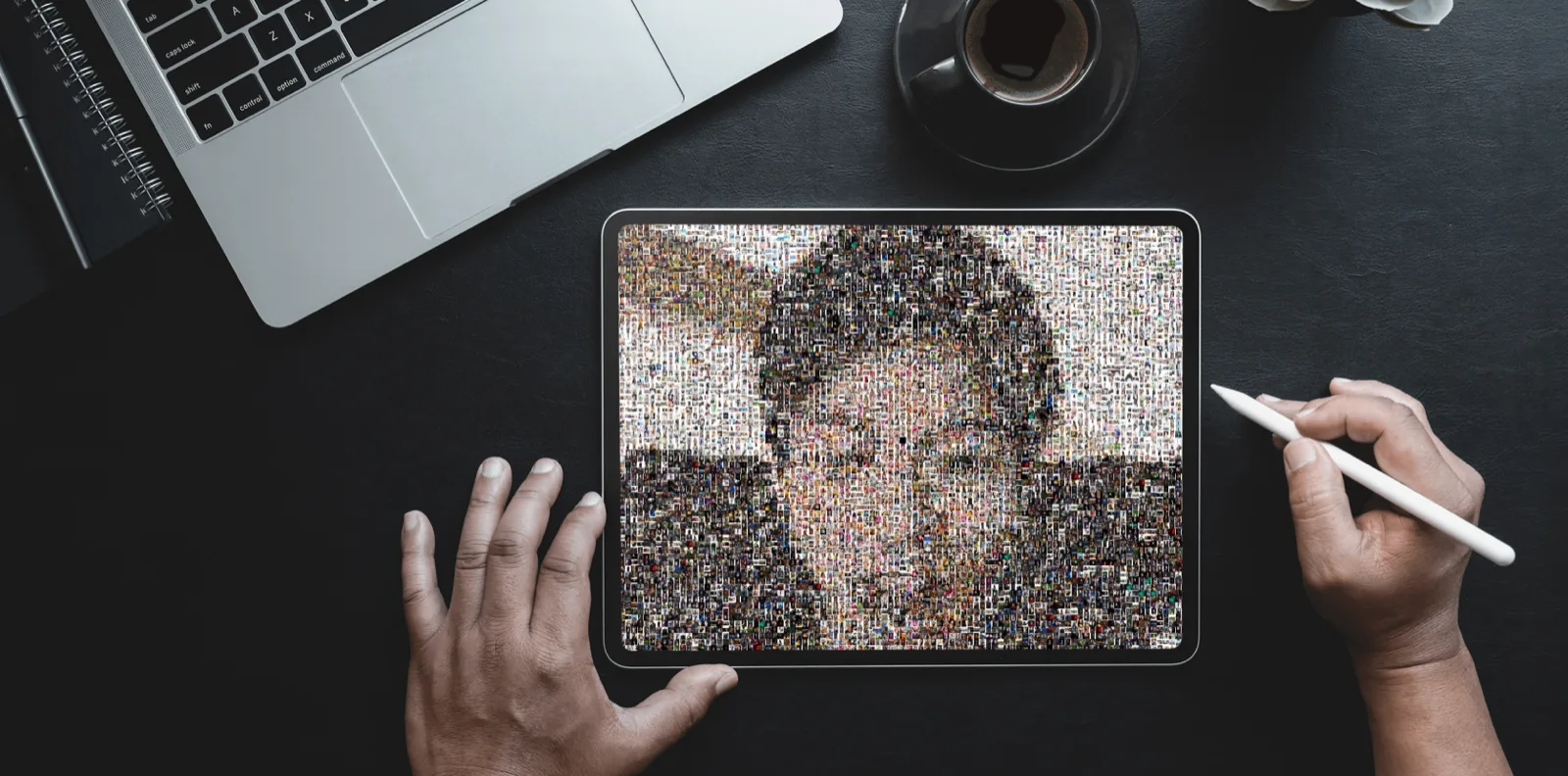
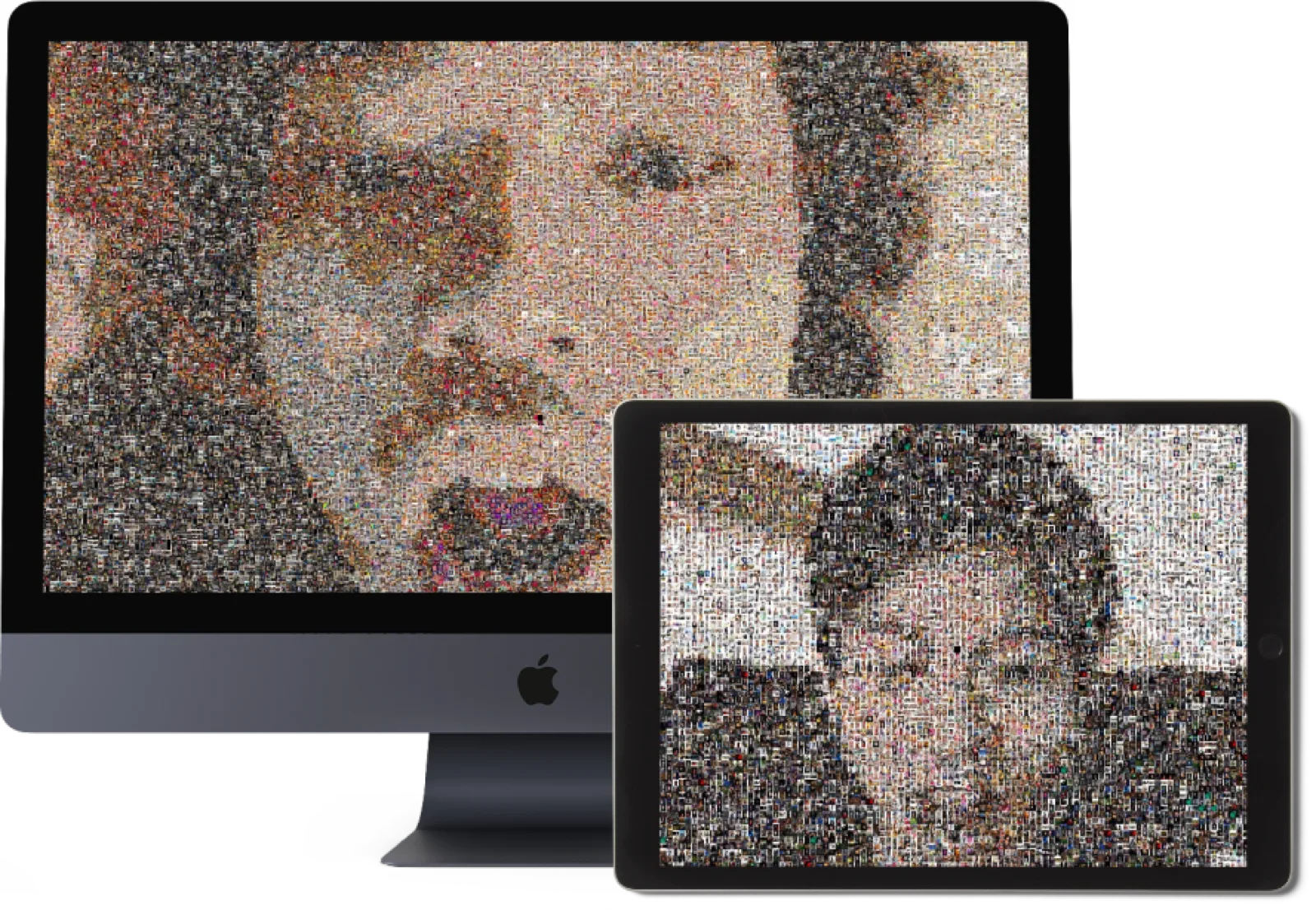
The mechanism is plain. Keep five thousand photographs whose subject is a face; divide the camera feed into tiles; fill each tile with a photograph close to its colour. From a distance it is your face. Up close it is made of strangers. Written in p5.js. Structurally it is a photomosaic that runs in real time.
One condition: no wall text. The moment a face built from other faces appears on screen, it has to read without words. If it needs explaining, the piece has failed.
Not searching five thousand images every frame
A photomosaic that moves in real time struggles to hold quality and speed at once. The canvas is 960 by 720 and a tile is five pixels square, so a frame holds 192 x 144 = 27,648 tiles. Choosing among five thousand candidates for every one of them comes to 138,240,000 comparisons per frame. Done directly, it does not finish in time.
So the search was removed. Cutting each of R, G and B into three bands gives twenty-seven boxes. The five thousand images are sorted into those boxes by average colour beforehand and written out as an index. At runtime a tile takes six comparisons, R then G then B, to land in a box, and one image is then drawn from that box at random. Six comparisons per tile, 165,888 for the whole frame: about one eight-hundredth of the direct approach.
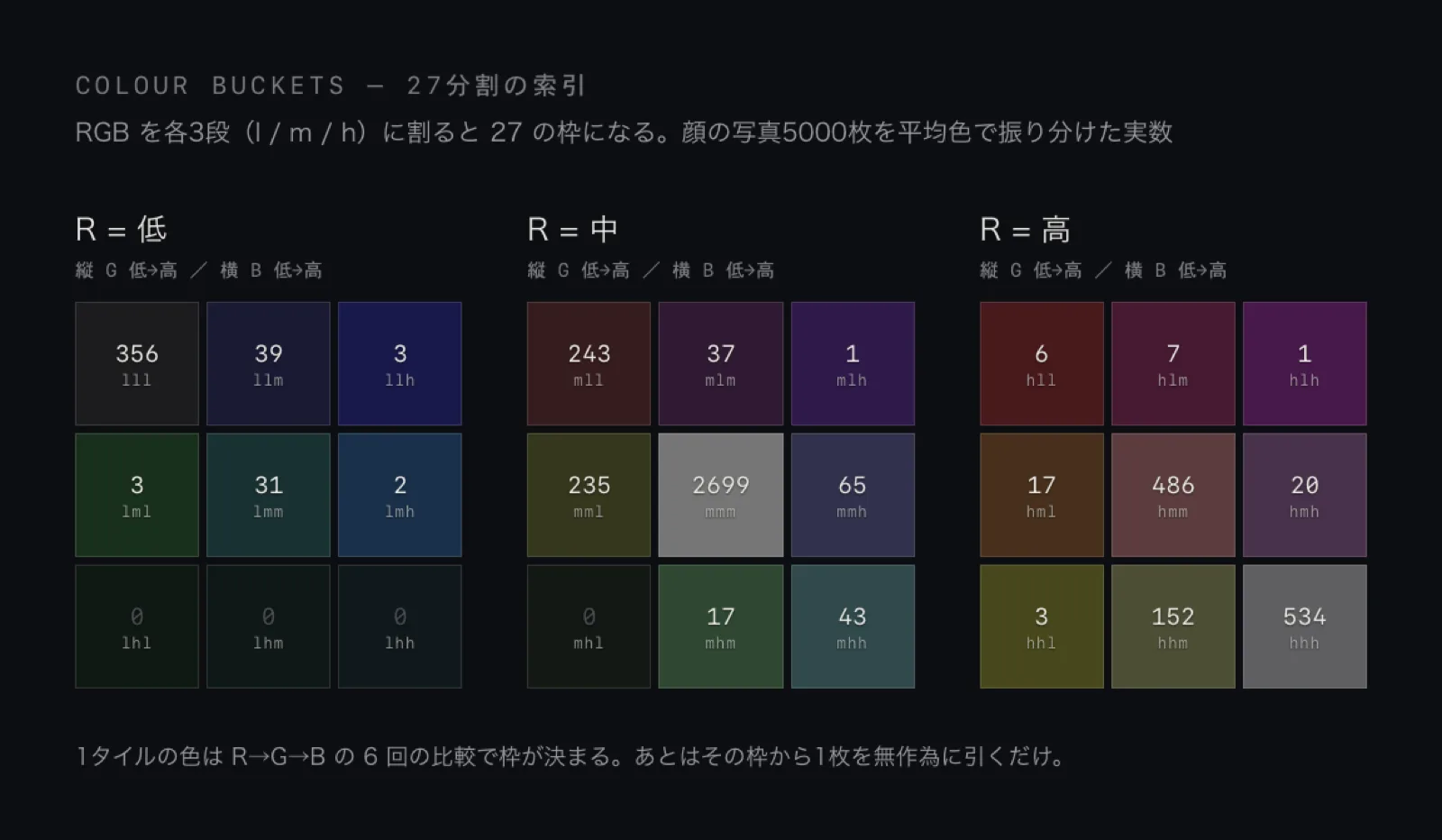
The method never picks the nearest image. It pulls a different one from the same box each time. A flat area of colour therefore never repeats a single photograph: from a distance it holds as a face, and up close every tile is a different person. The trick that makes it fast is also what makes it look the way it does.
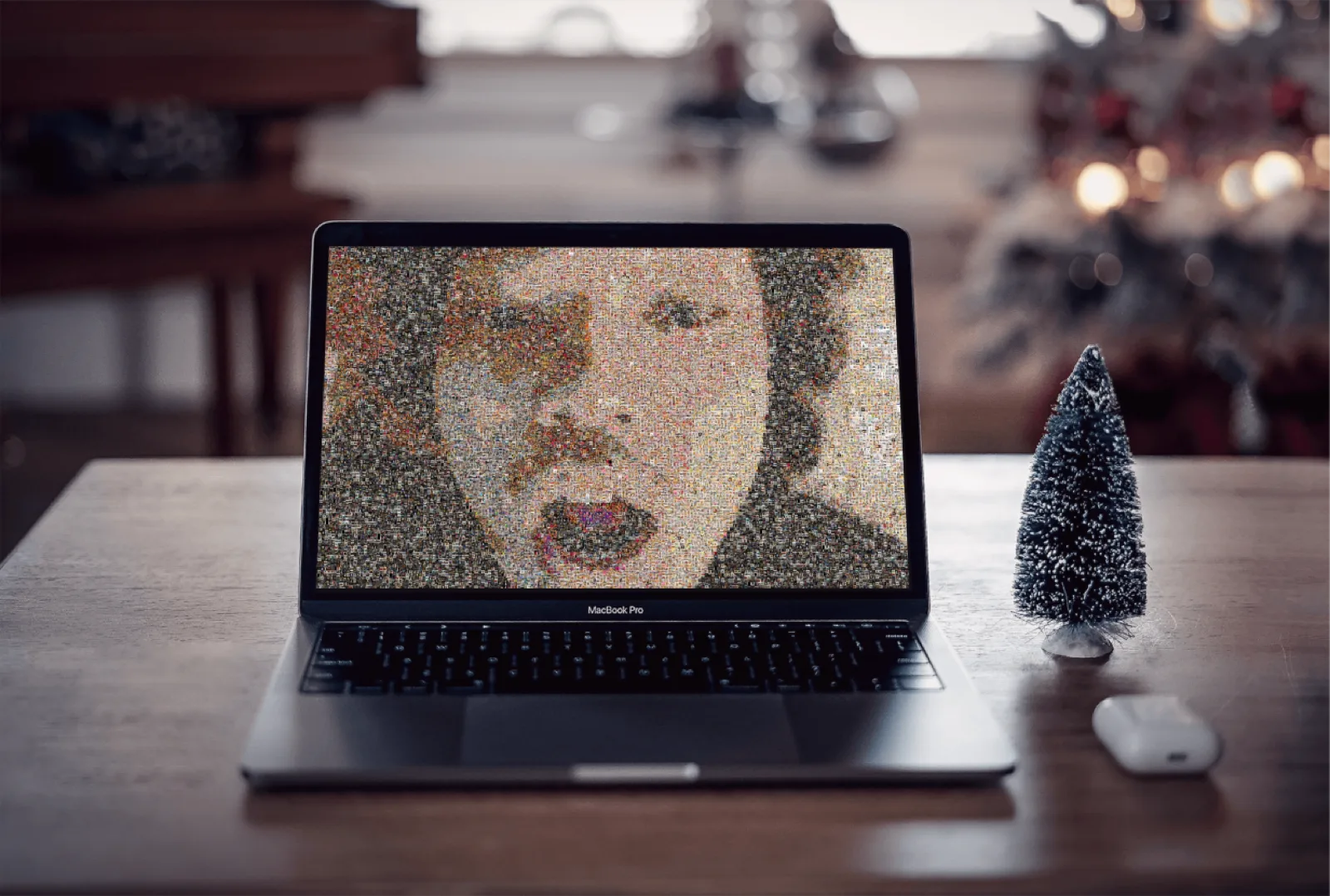
The distribution survives too. Of the five thousand, 2,699 landed in the central box. Faces are mostly skin, so the average colour crowds toward the middle. Four boxes took nothing at all. A band spans eighty-five levels, which is coarse: this does not match a colour accurately, it matches a band of colour.
The mechanism runs in the browser. The tiles are not faces, though: face photographs cannot be published, so cats and sunsets stand in.
Run it in the browserYour face on camera, rebuilt from three hundred photographs, live
Evaluating the work
The evaluation was a workshop of about an hour with eight testers, given shared context about Instagram before experiencing the work.
Asked whether they felt individuality gets buried on Instagram, most answered yes. One response was that their own existence felt swallowed, and that it was unpleasant. The intended sensation does land.
What that supports is that something latent in the participants was brought to the surface. No more than that.